
Persistant Organic Pollutants (POPs) Guidance

Starting in January 2023, new legislation came into force from the Environment Agency which involves the storage and disposal of waste upholstered domestic seating containing Persistent Organic Pollutants (POPs). We, as a waste disposal company and you, the client, must follow these new guidelines which in turn, will protect the environment from damaging effects.
What Are (POPS)?
Being aware of persistent organic pollutants (POPs) is critical in today’s world. POPs are long-living toxic chemicals that have devastating effects on the environment and human health. This blog post aims to raise awareness about POPs, their harmful impacts, and ways to mitigate these risks.
POPs are dangerous chemicals that are found in the fire retardents used on upholstered furniture. When these items are put into landfill, the chemicals break down very slowly and can eventually end up in the ground and consequently contaminate the food chain if not dealt with correctly. In the past POPs were found in organochlorine pesticides, such as DDT, industrial chemicals, polychlorinated biphenyls (PCB). Many of these compounds, such as DDT and polychlorinated biphenyls (PCBs), were once hailed as revolutionary inventions in the mid-20th century. Little did we know that these creations would morph into harmful pollutants causing long-term environmental damage.
Which Items Contain Persistent Organic Pollutants?
Waste domestic seating is any item of seating of a household type from households or businesses that is waste. The materials used in these items can include leather or foam. Some common examples are listed below-
*Sofas
*Office chairs
*Stools
*Kitchen chairs
*Dining room chairs
*Futons
*Bean bags
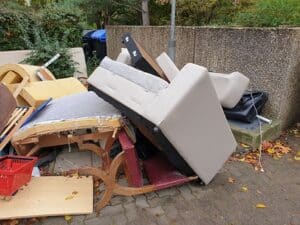
From March 2023 the items listed above will have their own disposal costs. To find out more on the prices of these items, please see our pricing page. You can be assured that when we collect any POPs items we take them all to a registered waste transfer station where they are dealt with separately from all other waste material.
Care needs to be taken when handling any POP items so as to not damage them and cause cross contamination of the chemicals with other waste materials. When we, as a registered waste carrier, handle these items we make sure they are covered and kept separately when in transit to avoid any contamination between different material. We recommend that you keep any of the items listed above separate from your other waste. We are fully licensed to take any of the items listed above, so if you are in need of any clearance of these items, then give us a call, and we’ll be happy to help.
Being in the waste disposal sector for 16 years, we think that this new legislation is a good move as it helps to protect the environment as well as our own well-being. We offer quick and efficient removal services for any POP items, so you can rest assured that it’s being dealt with correctly while adhering to the new guidelines. For any more advice or questions regarding this service, then more information is available from the governments POPS Guidance page.
Contact Us
Below are our contact details-
Tel: 07934 801140
Email: info@bin-and-gone.co.uk
If you fill out the boxes with your email address and other relevant details, it will come straight to our email inbox. We always reply on the same day.